
Back to: Falcon (Original)
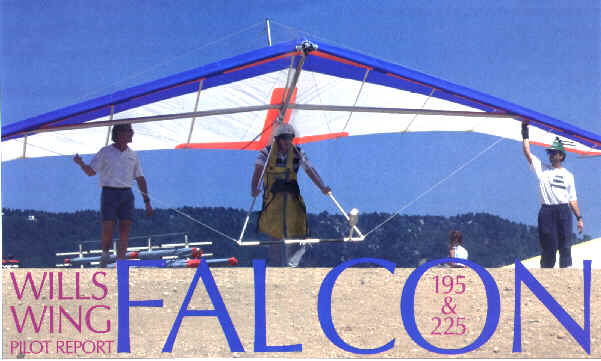
Pilot Report: Wills Wing Falcon 195 & 225
By Gil Dodgen
Originally published in Hang Gliding Magazine, December 1996. © 1996 United States Hang Gliding Association. Reproduced with permission. Photos by Mike Meier.
This review reflects the author's personal experience and assessment at the time of publication.
Let's face it. The hang gliding community is aging. When I got into the sport in 1973 I was 22, and an unmarried, foot-loose, fancy-free college student. I'm 45 now, and work and family commitments have taken their toll on my flying, as I'm sure they have for many others.
Flying high-performance gliders, especially in turbulent midday conditions, is demanding. The pilot needs to be current, and the gliders are heavy, time consuming and inconvenient to set up, often difficult to land, and not so reassuring in gnarly thermals. They are also expensive. Add these disincentives to the above-mentioned demands on one's time, and the result is likely to be a lot less flying.
Ken de Russy, who has been involved in the sport for as long as I can remember, recently commented to me, "Hang gliding is evolving itself out of existence." He then talked about the "hang gliding culture" and how it pressures pilots into flying higher, faster and farther on higher- and higher-performance gliders. The result: fewer people getting into the sport and more dropping out. Ken now teaches paragliding exclusively.
Enter the Wills Wing Falcon. It's light, a breeze to set up, phenomenally easy to fly, reassuring in turbulence and a piece of cake to land. And it costs half what a blade wing does. I really believe that if the "culture" can be changed, gliders like the Falcon may be instrumental in creating a hang gliding renaissance.
Setup
Setting up the Falcon is a breeze. Assemble the control bar at the corner bracket with a bolt, wingnut and safety. (The Wills folding basetube is an option.) Set the glider on the control bar, spread the wings (if the bridles are left attached this raises the kingpost), and stuff seven battens per side. It's nice not having to lacerate one's fingers when tensioning the batten strings. Tension the crossbar by pulling back the sweep wire and drop the keyhole tang into place at the rear of the keel. Install the washout tips and attach the front wires at the nose with another keyhole tang. Push the nose batten into place and you're done.
I expect that this whole procedure should take no more than four or five minutes with a little practice. Rob Kells claims that he can set one up in two minutes.
A Great Day of Flying
I recently had a chance to fly both the 195 and 225 Falcon at Marshall Peak near Crestline, California. It was a great day. USHGA Executive Director Phil Bachman was in town and flew tandem in both a paraglider and a Falcon with instructor extraordinaire Rob McKenzie. Roy Haggard and Larry Tudor also showed up to fly.
My first flight was in midday thermal conditions in a 195 Falcon. After a few steps I was in the air searching for some lift to climb out over Marshall and hopefully thermal back to Crestline. I immediately noticed how easy it was to turn the glider. I hadn't flown an entry-level glider in many years, and I'd forgotten what a joy it is to drive around the sky in a glider that quickly responds to control input with practically no physical effort or lag time. Turns coordinated easily and the glider was very easy to thermal. The slow-flight capability of the wing and the quick response, even at those low speeds, enabled me to really milk the lift for all it was worth.
In no time I was above launch and the lift was booming. I soon gained more than 3,000 feet over Marshall, with my trusty vario frequently pegging at 1,000 fpm. Even after a significant hiatus from flying, at no time did I feel uncomfortable in the turbulence. Later, both Mike Meier and Rob Kells agreed that the thermal turbulence that day was an eight on a scale of ten. I can only assume that the glider's stability, controllability, damping and aeroelasticity soaked up the bumps.
With all that altitude I decided to see what the glider would do with the bar at my knees. It was nice to discover that, unlike the Super Sport, there was no tendency for the wing to oscillate at high speeds, and I was able to fly straight and true even in the bumpy air. The glider seemed to be flying quite fast, and although I didn't have an airspeed indicator, I'll bet I was getting in excess of 45 mph with my 220-pound hook-in weight in the 195. Bar pressure at speed is substantial enough to be reassuring, but not fatiguing. I was surprised at how well the single-surface sail held up at these bar-stuffed speeds.
As should be expected from a single-surface design, the glider comes down fast when flown at its top end. However, in my opinion, the glider penetrates well enough and gets a good enough L/D at normal cruising speeds that a pilot should be able to do 93.785% of the stuff he does in a high-performance glider on a typical day of recreational flying.
I had no problem gaining 3,000 feet of altitude in turbulent lift — in short order. In fact, it would probably have taken longer in a high-performance ship since I wouldn't have been able to core as tightly. I was able to cruise the mountain range and fly back out, just as I have done multitudinous times in higher-performance gliders at this site. It just took a little longer.
After bleeding off copious altitude I set up a standard downwind, base and final approach. It was so easy! I just floated in and flared. It was like stepping off a chair. Landing the 225 was like stepping off a curb.
The 225
It's too bad the name "Super Floater" is already in use, since that perfectly describes this glider. On my second flight of the day in a 225, I was joined by Phil Bachman who was flying tandem with Rob McKenzie in another Falcon 225. It was great fun cruising around in the sky with USHGA's illustrious Executive Director.
At the end of the flight, as I was homing in for a landing, I had the opportunity to fly for about 10 minutes with a bird — nearly wing tip to wing tip. Our airspeeds were nearly identical. I have done this a number of times in the past, but this experience reminded me of what hang gliding is all about: the realization of man's age-old dream of flying like the birds. I was flying like a bird, with a bird. (I don't know my birds very well. Maybe it was a falcon.)
The Manual
The Falcon owner's manual is superb. The manual is thorough and comprehensive, and includes information on setup, maintenance, flying and landing, tuning, using the wing tufts, speeds to fly and using an airspeed indicator, transport, and the glider's certification. It's packed with useful information. At the end there are exploded views of all the glider components with part numbers and specs. It's amazing how many parts there are even in such a "simple" wing.
Conclusion
I highly recommend the Falcon to anyone who is just getting into the sport of hang gliding. I would also suggest that it might make a nice second glider for experienced pilots who want the convenience, ease of setup, and reassuring flight and landing characteristics that this glider has to offer. I also believe that the Falcon would be an excellent choice for paraglider pilots who would like to get a taste of their sister sport.
Finally, for those who don't fly as often as they used to, or those who have dropped out of the sport altogether because of the hassles inherent in flying high-performance gliders, life's demands and commitments, or the inability to stay current, the Falcon might just be the ticket to bring you back into flying.