
Back to: Fusion
Pilot Report: Wills Wing Fusion 150 — Approaching Perfection
By Dennis Pagen
Originally published in Hang Gliding Magazine, September 1997. © 1997 Dennis Pagen. Reproduced with permission.
This review reflects the author's personal experience and assessment at the time of publication.
See also: The Story of the Design and Development of the Fusion by Steven Pearson
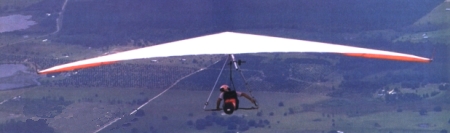
My first flight on the current version of the Wills Wing Fusion was trial by fire. I had arranged for a glider to try during the King Mountain meet in Idaho. The problem was timing. During the previous two weeks I was running a World Hang Gliding Series meet in Greece. So I jumped on a plane on Friday at 7:30 am in Athens, and 23 hours later arrived at King Mountain. I snatched 40 winks and awoke the morning of the first competition day. To my surprise, my borrowed glider was lying on the ground next to my van. Not only was this Fusion brand new but it came with a cross-country bag and a hat to boot. I started out that day with a smile thanks to Wills Wing's extra effort.
But the smile soon faded when we went up the hill to find winds of over 30 mph. How would the glider handle in turbulence? Would I feel secure with its stability? What about its performance? Most of my doubts were answered soon after launch, as I climbed out effortlessly. Turbulence was mild and I easily penetrated the higher winds aloft to get my start photo. I eventually made goal on this strong crosswind day and walked around the glider with a smile on my face. I stroked the membrane, ogled the clean, curvaceous upper surface, kicked the tires and mused: "I believe Wills Wing has made the perfect glider."
Perfection is hard to come by in my cosmos, so after the first flush of infatuation abated I looked more critically for flaws. I did find a minor point or two which we shall report in due time, but it is clear to me that Wills Wing has fused all the good ideas from their previous gliders with a few new items to achieve a design that approaches perfection.
Topless Topics
No doubt every pilot with a pulse has become aware of the topless glider revolution. The promise is improved performance, but this improvement comes at a price. This price must be paid not just in dollars, but also in weight and possibly stability.
Safety is most important to me because I fly for fun, and it is not fun to be continually in doubt about a glider's integrity. Controllability, strength and stability are the main safety factors, and these are all tested to a certain degree during the HGMA certification process. The Fusion has passed its HGMA tests handily, but the proof is in the flying.
During the 13+ hours I flew the Fusion at King Mountain I never felt insecure when it came to the glider's structural integrity, controllability or stability — this, despite a consensus that many of us encountered some of the strongest winds and turbulence in our competition experience. In my opinion the Fusion feels as solid and dependable as any kingpost equipped glider.
Pitch Stability
Without a kingpost a glider cannot have reflex bridles (lufflines). These pitch stability devices are most useful when a negative angle of attack is encountered in a gust or incipient pitchover. Without reflex bridles some other method is required to slow or stop a glider's negative pitching motion. Enter sprogs.
A sprog is simply a glorified washout strut that limits how much the rear of the sail can blow down at the sprog location. The Fusion's sprogs ended up about 70% out on the leading edge. The addition of a transverse batten parallel to the trailing edge to spread the sprog's influence, as well as conventional washout struts at the tips, complete the minimum twist-limiting package.
Other pitch stability systems on the Fusion include the upper-to-lower sail connections, the reflexed root section and the airfoil shape. Notably, the airfoil is thickly cambered with a well-forward high point which leads to good climbing ability and good pitch stability respectively. In my estimation a properly-set-up and maintained Fusion is as stable in pitch as conventional kingposted high-performance gliders.
Fusion Performance
It should be no surprise to most that the Fusion will out-glide conventional gliders, as do most topless gliders. But how does the Fusion climb? Rumor has it that the Fusion was constantly compared with the best-climbing glider available during development, and it wasn't released until it matched up. I can report that in my own experience I never felt outclassed in climb with my Fusion. More tellingly, many other pilots in hundreds of comparison competition climbs reported a similar experience.
Near best glide speed the Fusion matches any other topless glider you care to pull off the truck. The Fusion is equal to everything out there in the weight-shift world, and pilots with top-rigged gliders will enjoy an increment of performance if they trade up.
Handling the Fusion
The Fusion's VG works with levers out at the end of the crossbars that push the leading edges forward by effectively lengthening the crossbar. This system is very efficient in that it provides a tremendous mechanical advantage. Thus, the VG rope offers very light resistance and the total pull length is not excessive. The VG effect on the Fusion is equivalent to moving the crossbar twice as far as on a Wills Wing XC.
In the loose VG setting the Fusion's handling can best be described as sweet. Turn initiation was easy and responsive while coordination was, well, coordinated. No tricks, no surprises, no sweat.
I could detect no tendency to wingwalk or Dutch roll. The Fusion's handling is quite light with a solid feel during turn coordination. The terms "confidence inspiring" and "predictability" come to mind when talking about the Fusion's handling.
Getting Off and Coming Down
Taking to the air in a Fusion is a nice experience. The launch itself is facilitated by the fact that the VG system keeps the side cables tight throughout the VG range. Another nice launch benefit is the Fusion's fine static balance. You can lighten up your grip before you launch because you don't have to force the nose down.
Landing the Fusion is straightforward and easy. I did it in a crosswind, in gusts, in strong wind and in light wind, as well as with the VG on in strong wind. My conclusion is that the glider lands very easily without an overly-critical flare window. Recreational pilots should not fear that the Fusion will require any more than their usual landing skills.
Setup, Hardware and Appearance
The Fusion's designer, Steve Pearson, was the inventor of the crescent-shaped inserts that allow tubes to be stepped down to any size and thus free designers of hang gliders to more readily follow their imagination. With the Fusion, Steve took the concept one step further. He placed a crescent insert at the end of the inboard leading edge tube with a circular insert further in. The result is that the outboard leading edge is no longer held parallel to the inboard piece, but tilts forward and down. This partially compensates for the usual bowing of the outboard leading edge under flight loads.
The rest of the Fusion's hardware and layout is admirably functional. Note especially the graphite crossbar shape. Its curved tips allow the lower surface sail to under-camber a bit for good lift production. The unique Wills Wing folding base tube comes stock on the Fusion. Also, the downtubes are a new extrusion made exclusively for Wills Wing with an extra boundary layer trip strip.
On Final
Wills Wing has been in the business a long time — since 1973. They will certainly continue their success well into the future if they keep turning out products like the Fusion. This is almost an every-man's glider. This is almost a perfect glider. If moving up to a new topless glider is your destiny, be sure to test-fly the one that is a synthesis of some of the best ideas that fly — the Fusion.